
Last updated: September 2026
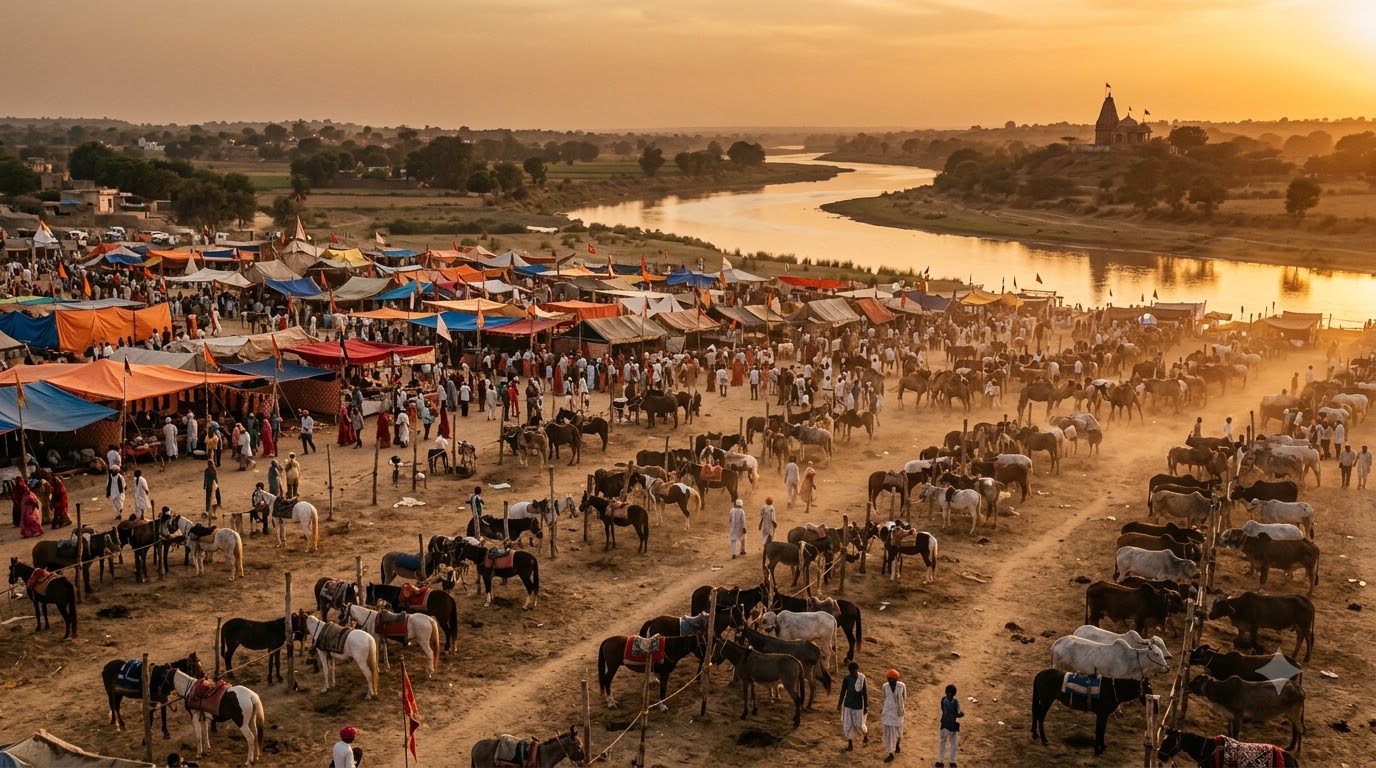
Twenty-five kilometers from Patna, at the exact spot where the Ganga meets the Gandak river, sits a fair so old its origins blur into legend. Some accounts trace Sonepur Mela back over 2,300 years, to Chandragupta Maurya himself buying elephants and horses here for his army. Today, it remains Asia’s largest cattle fair — a month-long spectacle of livestock trading, folk performances, and religious devotion that most of India has never even heard of.
Quick Facts
| Location | Sonepur, Saran district, Bihar — confluence of the Ganga and Gandak rivers |
| Distance from Patna | Approx. 25 km |
| 2026 dates | November 22 – December 23 (32 days) |
| Also known as | Harihar Kshetra Mela |
| Timed to | Kartik Poornima (the full moon in the Hindu month of Kartik) |
| Historical origin | Traced by some accounts to the Mauryan period (4th century BCE) |
| Nearest railway station | Sonepur Junction |
| Nearest airport | Patna (Jay Prakash Narayan International Airport), ~25 km |
A Fair Old Enough to Blend Into Mythology
The area hosting Sonepur Mela carries the name “Harihar Kshetra” — combining Hari (Vishnu) and Hara (Shiva). Local legend ties this name to Vishnu, who intervened in his Narasimha form during a battle between an elephant and a crocodile at this exact spot. The Harihar Nath Temple here predates the fair itself, and likely explains why people first began gathering at this confluence.
Historically, the fair wasn’t always held in Sonepur. According to a British administrative officer’s 1919 travelogue, it once spanned over 43 villages, with temple rituals originally centered in nearby Hajipur. Under the reign of Mughal emperor Aurangzeb, the fair’s venue shifted to Sonepur, and it grew from there into the sprawling, monumental event that continues today. At its historical peak, traders reportedly traveled from as far as Central Asia to buy and sell animals here.
What Happens at Sonepur Mela Today
Spanning up to a month, the mela transforms the riverbank into a temporary town of livestock enclosures, stalls, and performance areas. Elephants were historically the fair’s signature trade, but regulators restricted elephant sales in 2017 under animal welfare rules. Today, the trading floor centers mainly on horses, cattle, and other livestock, alongside a vast bazaar of handicrafts, textiles, and Bihari street food.
Beyond the animal trading, the fair includes folk performances, traditional games, and cultural programs running across its full duration. In fact, Saran district’s 2026 administration has specifically set up a Cultural Program Cell just to schedule events across all 32 days. Bihar State Tourism Development Corporation typically adds Swiss cottages and a tourist village near the fairgrounds too, offering amenities like internet access and boat rides on the Gandak River for visitors who’d rather stay onsite than commute from Patna.
How Patna Prepares for It
The scale of Sonepur Mela is significant enough that Saran district’s administration treats it as a major logistical undertaking. For 2026, officials have set up 14 dedicated cells to manage it all. These cover everything from temporary electrification across Sonepur and Pahleja Ghats, to veterinary services for the livestock, to dedicated police outposts and drinking water and sanitation facilities for the fair’s full duration.
How to Reach Sonepur Mela
- By road: Drive across the Mahatma Gandhi Setu, the bridge connecting Patna to Hajipur/Sonepur — roughly 1.5-2 hours during peak mela days when traffic is heaviest
- By ferry: Country boats and motorized ferries run from Patna’s Mahendru Ghat directly to Sonepur Ghat, a more scenic alternative to the road route
- By rail: Sonepur Junction is well connected to major cities including Delhi, Kolkata, Mumbai, and Chennai
- By air: Patna’s Jay Prakash Narayan International Airport is the nearest airport, about 25 km away
Best Time to Visit
The fair’s opening days around Kartik Poornima tend to be the most crowded and ceremonially significant, drawing the largest religious gathering at the Harihar Nath Temple. If you’d rather experience the market and cultural programs with lighter crowds, visiting a week or two into the fair’s run often strikes a better balance.
Nearby Content on Beauty of India
Frequently Asked Questions
What is Sonepur Mela? Sonepur Mela, also called Harihar Kshetra Mela, is Asia’s largest cattle fair, held annually near Patna, Bihar, at the confluence of the Ganga and Gandak rivers. Some accounts trace its origins back over 2,300 years.
When is Sonepur Mela 2026? Sonepur Mela 2026 runs from November 22 to December 23, spanning 32 days.
Is elephant trading still part of Sonepur Mela? Elephant sales have been restricted since 2017 under animal welfare regulations. Today, the fair’s livestock trading centers mainly on horses and cattle, alongside a large handicrafts and food bazaar.
How far is Sonepur Mela from Patna? Approximately 25 km, reachable by road via the Mahatma Gandhi Setu bridge, or by ferry from Patna’s Mahendru Ghat.
Why is the area called Harihar Kshetra? The name combines Hari (Vishnu) and Hara (Shiva), tied to a legend involving Vishnu’s Narasimha avatar intervening in a mythological battle between an elephant and a crocodile at this exact site.
Is Sonepur Mela worth visiting as a tourist? Yes — it offers a genuinely rare, large-scale glimpse into rural Bihar’s culture, trade traditions, and religious life, alongside folk performances and one of the most historically significant fairs still running in India today.
